
Originally Posted on The Coaching Tools Company as Building Coaching Capacity in Leaders and Peers: Why Shared Coaching Capacity Matters in the Era of AI | by Jennifer Britton

We are in an era where the world of work is shifting dramatically. Change is continuous. Tension and paradox are part of the fabric of work. Decisions are increasingly made in ambiguous spaces.
Decisions are made “in flight” and while the plane is being built.
AI is increasingly handling structured, predictable work in many contexts, leaning into its strengths of summarizing, drafting, analyzing, and generating options.
The question is no longer whether leaders should learn coaching skills. The question is whether we are building coaching capacity — across leaders and peers — as part of this shift.
From Skill to Capacity
Coaching skills matter. They provide language, structure, and confidence. With where the world is right now, it’s important to go beyond skills to capacities.
By capacity, I don’t mean another competency or a framework. I mean the underlying ability to operate in a certain way, consistently, especially under pressure. Capacity is what remains when conditions are uncertain. It shapes how we think, relate, create, and adapt in real time.
Building capacity is about creating the conditions for people and systems to sustain performance, creativity, and connection, without burning out in the process.
In complex environments, coaching capacity strengthens our ability to read the terrain, navigate uncertainty together, and design conversations that sustain collaboration.
When terrain shifts, because of technological change, competing demands, or rising tensions, capacity determines whether individuals, teams, or organizations fragment or move forward with intention.
Capacity shows up:
- When a colleague pauses before reacting.
- When a peer asks, “What might we be missing?”
- When tension is named rather than avoided.
- When a team pauses and reflects before accelerating again.
Why AI Raises the Stakes
As AI handles more routine cognition, human work shifts. It becomes less about processing information and more about interpreting it. Less about producing output and more about meaning-making. Less about authority (the knowing) and more about facilitation (the process).
AI can generate options, but it cannot build trust.
AI can synthesize information, but it cannot regulate emotion in a difficult conversation.
This is where coaching capacity becomes critical, not as a leadership technique, but as a shared capability that allows teams and communities to think, adapt, and create together.
In an AI-enabled world, human capacity becomes the differentiator.
Coaching Capacity Is Not Just for Leaders
For too long, coaching has been positioned primarily as something leaders do. For years, I have argued that in virtual, remote, and hybrid environments (complex systems), capacity and coaching cannot sit only at the top. It must be shared. In the workspaces of tomorrow, where everyone may be leading agentic teams, equipping everyone with coaching capacities becomes important.
This means equipping everyone with coaching capacities to:
- Ask clarifying questions
- Expand the realm of “what’s possible”
- Support and challenge one another’s thinking
- Reflect together on what is emerging
So that learning accelerates, tensions and dichotomies can be held, and resilience strengthens.
In many settings, the greatest leverage lies not in developing one exceptional coaching leader, but in strengthening the coaching capacity of the group, team, or culture.
As I have shared this viewpoint over the years at other inflection points, like the shift to virtual work, this viewpoint has not been popular with everyone. It signals a paradigm shift in roles, power, and accessibility.
As we widen the lens to coaching capacity for everyone, it can look like many things. Shared coaching capacity is already visible across sectors.
It shows up in:
- Entrepreneurial mastermind groups where members challenge assumptions rather than simply exchanging advice
- Healthcare teams using structured debriefs to examine communication patterns, not just outcomes
- Educators in professional learning communities reflecting on the thinking behind their strategies
- Nonprofit coalitions surfacing tensions between mission and resources before misalignment deepens
In these spaces, no one may hold the formal title of “coach,” yet coaching capacity is present. Questions are welcomed. Assumptions are surfaced. Reflection is a part of the process. Learning becomes shared.
The Capacities That Sustain Coaching Cultures
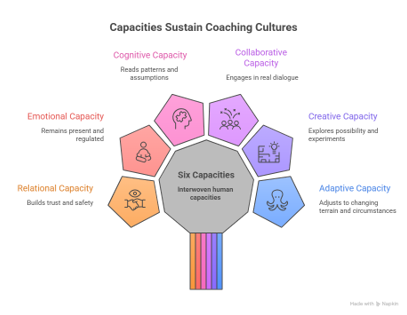
When we speak about coaching capacity, we are speaking about interwoven human capacities, which I share in my upcoming book, The Capacity Playbook. The six capacities are:
Relational Capacity: The ability to build trust and psychological safety so people feel safe to contribute, question, and engage honestly.
Emotional Capacity: The ability to remain present and regulated under pressure. Staying grounded rather than reactive.
Cognitive Capacity: The ability to read patterns, surface assumptions, and make thoughtful sense of what is unfolding.
Collaborative Capacity: The ability to engage in real dialogue and shared ownership. Navigating differences without defaulting to hierarchy or silence.
Creative Capacity: The willingness to explore possibility, experiment with new paths, and imagine alternatives when the terrain shifts.
Adaptive Capacity: The ability to adjust as the terrain changes without losing grounding in shared values, purpose, or relationship.
|
Facilitating Opportunities for Coaching Capacity Development
Building shared coaching capacity does not require launching another program, but it does mean a shift in how people work together.
It may mean:
- Embedding short reflection pauses into regular meetings
- Creating simple peer coaching rotations within teams
- Normalizing the naming of tension before it hardens
- Encouraging small experiments rather than prolonged debate
- Creating space for leaders and peers to examine their own patterns
Capacity grows through repetition. Through rhythm. Through micro-moments.
It grows when reflection becomes part of how we work, not something we do afterward.
A Reflective Pause
As you consider your own organization, peer network, or client system, ask:
- Where does coaching currently live?
- When pressure rises, what happens? Do conversations narrow, or deepen?
- What small shift in rhythm might strengthen capacity over time?
From Expertise to Infrastructure
The goal is not to turn everyone into a professional coach; rather, it is to create environments where:
- Reflection happens regularly with micro-pauses in all sorts of formats (huddles, peer meetings, end of day)
- Tension is surfaced early
- Learning is continuous
- Creativity is supported
- Adaptation is possible
In an AI-enabled world, technical advantage is increasingly accessible. Human coaching capacity is not.
Organizations and communities that intentionally cultivate shared coaching capacity and build coaching cultures with peers and leaders are strengthening the very qualities technology cannot replace.
This may be one of the most strategic investments we can make for the future of work.
If you enjoyed this article, you may also like:
- How to Use Group Coaching for Leadership Development by Jennifer Britton
- The Coaching Industry 2025: Beyond the Boom—Seven Trends Reshaping Our Profession
- Beyond Judgement by Dr Steve Jeffs