
Originally Posted on The Coaching Tools Company as Designing Leadership Workshops and Webinars That Stick with the 4A Model | by Jennifer Britton

Leaders, coaches, and consultants are speaking more than ever.
Short webinars.
Leadership workshops.
Lunch-and-learn sessions.
Conference presentations.
Yet many of these sessions feel rushed, surface-level, or quickly forgotten.
The issue usually isn’t time. It’s design.
When workshops and webinars are intentionally structured, even a short session can spark insight, meaningful conversation, and practical action.
One framework I often use when designing leadership sessions is what I call the 4A Model.
The 4A Model for Speaking and Leading Workshops
Effective workshops and webinars typically move through four stages: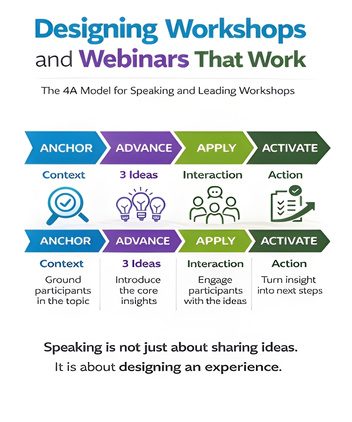
Anchor → Advance → Apply → Activate
Each stage helps participants move from awareness to action.
1) Anchor (Context)
Begin by grounding participants in the topic.
- Why this topic?
- Why now?
- Why does it matter to this audience?
- What’s in it for you? (WIIFM)
A strong opening might include:
- A question that invites reflection (What….)
- A short story or scenario (Consider this…)
- A data point or trend (Did you know…)
- A quick poll or chat prompt (Share with us….)
Anchoring helps participants connect the topic to their own experience and prepares them to engage.
2) Advance (Core Ideas)
Next, introduce the key insights you want participants to take away.
In shorter sessions, restraint is important.
Focus on three core ideas.
Not eight.
Not twelve.
Three.
When participants can clearly see the structure of the ideas you are sharing, they are much more likely to remember and apply them.
3) Apply (Engagement)
Engagement is at the heart of great conversations. Learning deepens when participants actively engage with the material.
Application or engagement might include:
- Small group discussions
- Breakout conversations
- Reflection questions
- Chat-based prompts in virtual sessions
- A short activity to test an idea
Even brief interaction helps participants translate insight into relevance. For those leading in the virtual realm, consider how you can integrate the Five Engagement Levers™ – Chat, Polling, Annotation, Breakouts and Whiteboard.
4) Activate (Action)
The final stage helps participants turn insight into action.
Before closing the session, invite participants to reflect:
- What is one idea that stood out to you today?
- What will you try this week?
- What conversation might you initiate?
Ending with a clear next step helps extend the impact of the session beyond the room or the webinar.
Design Principles for Leadership Workshops and Webinars
Whether you are leading a 60-minute webinar or a half-day workshop, a few design principles can help increase impact.
- Depth over breadth
Focus on fewer ideas and explore them meaningfully. - Interaction every 7–10 minutes
Frequent engagement keeps attention and energy high. - Use one clear visual model
A framework helps participants organize their thinking. - Offer one practical tool
Something participants can immediately apply. - Create a moment of reflection
Reflection turns information into insight.
Workshops and webinars should spark thinking and conversation, not overwhelm participants with content.
Common Pitfalls When Leading Sessions
Even experienced presenters sometimes fall into predictable traps:
Too much content
Too little interaction
No opportunity for application
No clear integration at the end
Another missed opportunity is continuation.
If you want your workshops and webinars to have a longer impact, consider offering something participants can return to afterwards, such as:
- Reflection questions
- A short worksheet
- A peer discussion guide
- A list of additional resources
These simple additions help sustain learning beyond the session itself.
Wrap Up
Speaking and leading workshops is not just about sharing ideas. It is about designing an experience that engages your audience.
When sessions are intentionally structured, even a short webinar or workshop can create meaningful learning and forward momentum.
The 4A Model — Anchor, Advance, Apply, Activate — provides a simple structure for designing sessions that are engaging and memorable, and move people into action.